Appreciating the People Behind Judo
Published by David J. Ellis
When we talk about judo, we usually talk about the people on the mat. We talk about the judoka who train, the coaches who teach, the referees who officiate, and the competitors who step up and compete.
But there are a lot of people involved in judo who never put on a gi.
They are the spouses, parents, grandparents, and volunteers who spend their weekends at tournaments. They keep score, run brackets, help with registration, and do whatever needs to be done to make a tournament work.
Judo needs these people, even if they don't always get noticed.
Alicia and Judo
My wife, Alicia, has never stepped foot on a judo mat. She has never put on a judo gi or learned a throw. But she has been part of my judo journey for a long time.
I remember taking her to a tournament early on. She had never been to a judo tournament before and really didn't know what went on behind the scenes. But she walked over to the table where the technical officials were working on the brackets and asked if they needed help.
From then on, she worked a lot of tournaments. Most of the time, that meant setting up brackets and then running pool sheets once the matches got going. Eventually, she learned enough about how tournaments worked that the people running them could depend on her.
Looking back, I realize how much of a commitment that was. For a lot of years, she gave up her weekends for something that wasn't really hers.
She did it because it mattered to me.
Then Johnny Got Involved
Johnny was born in March 2001, and about a month later, Alicia and I were the Head Technical Officials for the 2001 USA Judo Senior Nationals at Disney's Wide World of Sports Complex.
Looking back, I'm not sure what we were thinking. We were first-time parents with a one-month-old baby, and we were also responsible for technical operations at a national judo tournament.
I remember loading what seemed like everything we could possibly fit into my stepmother's van. With a new baby, you can imagine how much stuff we thought we needed. And we didn't go alone. Our parents came along to help with Johnny while Alicia and I worked the tournament.
That tournament is one of those memories that stands out to me now. At the time, we were just doing what we needed to do. We had a responsibility to the tournament, and we had a new baby to take care of.
Alicia had already been involved in judo tournaments for years, even though she had never trained on the mat. Now she was doing it with a one-month-old son.
Our parents were part of it too.
That's something I probably didn't appreciate enough at the time. Judo wasn't just something I did. It involved my family too.
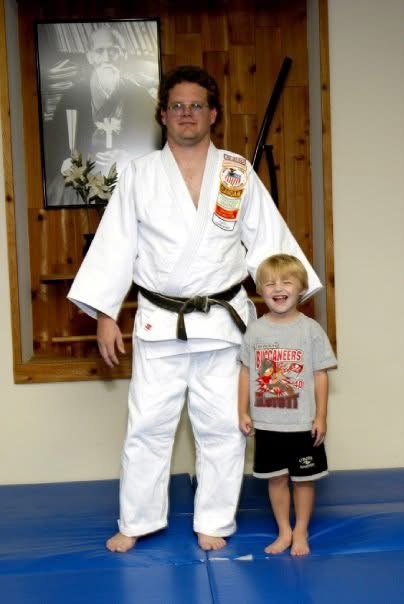
Johnny eventually started learning judo himself. He trained from about three years old until he was seven.
Even after he stopped training, he still found ways to help at tournaments. One of those ways was running the computer scoreboard.
He wasn't putting on a gi anymore, but he was still involved.
The People You Don't See
When you watch a judo tournament, it's easy to concentrate on what's happening on the mat. You see the judoka bow in, the referee take their position, the match starts. That's what everyone is watching.
What you don't always see are the people making all of that possible.
Someone had to register the competitors and set up the brackets. Someone, like Johnny, had to run the scoreboard and keep track of what was happening on several mats at once.
A lot of times, those people are parents, spouses, or other family members, people who have never put on a gi.
Or, like Johnny, they may have learned judo when they were younger and later found another way to stay involved.
It Takes More Than Judoka
One thing I've learned over the years is that judo is bigger than what happens during the time we spend on the mat.
A judoka's family makes sacrifices that don't always get recognized.
There are weekends spent driving to tournaments. Early mornings. Long days sitting in a gym. Meals eaten at odd times.
They're there because someone they care about is doing it.
So when I see a parent working a scoreboard or a spouse sitting behind a tournament table, I see someone supporting judo.
I've seen that firsthand in my own family.
They both helped in their own way, Alicia at the bracket table and Johnny on the scoreboard, and that's something I appreciate more now than I probably did when I was younger.
Judo teaches us Jita Kyoei, mutual benefit and welfare. We often think about that principle in terms of what happens between two people on the mat. But I think it applies off the mat too.
Judo works because people help one another. The judoka need the coaches. The coaches need the judoka. Tournaments need referees and officials. And all of them need the parents, spouses, and volunteers who give up their time to make it happen.
They may never step onto the mat, and their name never gets called over the microphone. But they're part of judo, and they deserve to be appreciated.