Teaching O Soto Gari
Published by David J. Ellis
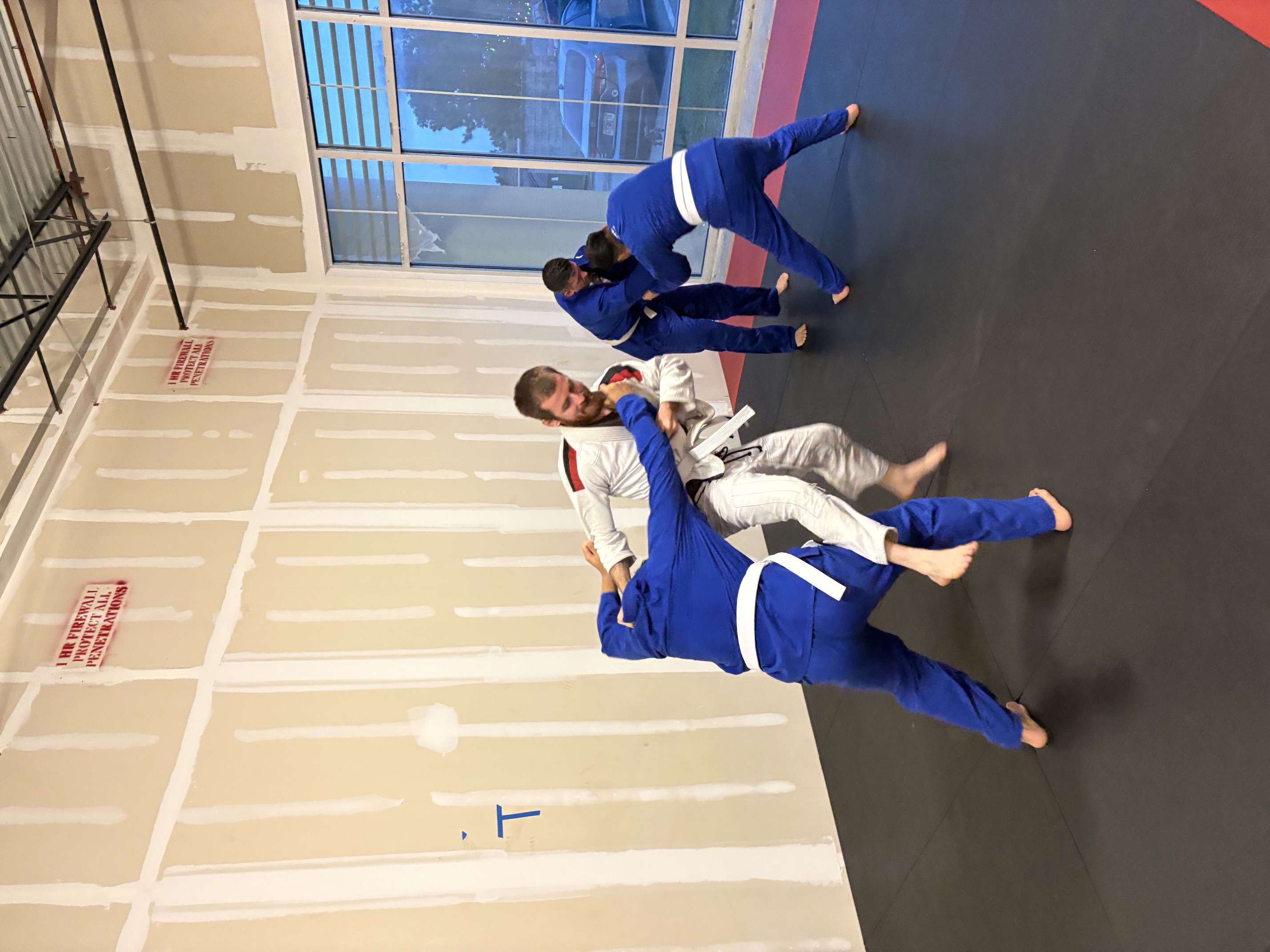
O Soto Gari (Major Outer Reap) is one of the first judo throws many students learn.
It’s also one of those throws that looks much easier than it really is.
When you watch someone who has been doing judo for many years perform O Soto Gari, it can look almost effortless. There isn’t a lot of wasted motion. The person moves, the balance is broken, the leg is reaped, and uke goes down.
Then a beginner tries it.
Sometimes the leg gets reaped but nothing happens. Sometimes uke simply steps away. Other times the student ends up standing beside their partner wondering why the throw didn’t work.
I’ve taught O Soto Gari for many years, and one thing I’ve learned is that the biggest problem usually isn’t the leg.
It’s getting the person into the right position before you try to reap the leg.
Start With the Grip
For a right-sided O Soto Gari, I teach the standard right-handed grip with my right hand on the lapel and my left hand controlling uke’s sleeve.
But I don’t want the left hand simply pulling down.
Instead, I want to pull the sleeve out to my left.
The purpose isn’t to see how hard I can pull uke’s arm. I’m trying to open up the position and move uke’s upper body so that I can get into the proper relationship with my partner.
I want to get armpit to armpit.
Once I’m there, I’m in a much better position to control uke and complete the throw.
Get Close
One of the mistakes I see with beginners is trying to do O Soto Gari from too far away.
They reach with the leg.
That’s usually a sign that the rest of the body hasn’t gotten close enough.
I don’t want my reaping leg reaching across a large gap between me and uke. I want my body close to uke, with our upper bodies connected.
Once I’m close, my body can help do the work.
That’s much better than trying to throw someone with my leg from several inches away.
The Left Hand Helps Open the Position
The left hand has an important job. By pulling uke’s sleeve out to my left, I’m opening uke’s right side and helping create the space and positioning I need to enter.
It’s not a matter of pulling the sleeve as hard as possible. In fact, using too much strength can make the movement worse.
The goal is to move uke’s upper body and create the opportunity for the throw.
This is one of those things that’s easier to understand when you actually feel it.
Then the Leg Becomes Important
Once I’m in the proper position and uke’s balance has been disrupted, the right leg comes into play.
For a right O Soto Gari, my right leg reaps uke’s right leg.
But I don’t think of the technique as simply kicking or swinging my leg at uke’s leg.
That’s not O Soto Gari.
The reaping leg works together with everything else.
My hands are controlling uke. My body is positioned correctly. My supporting leg gives me a base. Then my right leg reaps uke’s right leg while the rest of my body continues the movement.
The throw is the result of all of those things working together.
Don’t Stop the Reap
Another mistake I see is making contact with the leg and then stopping.
The student gets their right leg against uke’s right leg and thinks, I’ve got it.
No.
Keep going.
The reaping action needs to continue through the technique.
Think about reaping the leg away while continuing to control uke’s upper body. The leg isn’t just touching uke’s leg. It’s actively taking the leg away while the upper body is being controlled in the direction of the throw.
That’s an important difference.
Don’t Try to Muscle It
If you have to use all of your strength to make O Soto Gari work, stop and look at your positioning.
Something is probably missing.
- Maybe uke isn’t off balance.
- Maybe you’re too far away.
- Maybe you’re pulling in the wrong direction.
- Or maybe you’re trying to make the leg do everything.
Judo is supposed to teach us to use our body efficiently. O Soto Gari is a good example of that principle.
When the positioning and timing are right, the throw doesn’t require nearly as much strength as a beginner might expect.
Timing Matters
Even with good mechanics, timing makes a difference.
If uke is standing solidly with their weight distributed comfortably, O Soto Gari can be difficult.
But if uke is moving or their balance has been shifted toward the rear, the opportunity is there.
That’s why I don’t want students to think of judo as a collection of techniques they perform on command.
Judo is movement.
You have to feel what your partner is doing.
Sometimes the opportunity is obvious.
Sometimes it’s only there for a moment.
The more you practice, the easier it becomes to recognize those moments.
Teach the Reason, Not Just the Steps
When I’m teaching a beginner, I can give them a list of instructions.
- Right hand here.
- Left hand here.
- Step here.
- Pull here.
- Reap here.
That’s useful for getting started, but it isn’t enough.
I want the student to understand why they’re doing each part.
Why am I pulling the sleeve out to my left instead of simply pulling down?
Why do I want to get armpit to armpit?
Why does my body need to get close?
Why am I reaping uke’s right leg with my right leg?
Why doesn’t the throw work very well if I just swing my leg at uke?
Once a student understands those things, O Soto Gari starts to make more sense.
They’re no longer just trying to remember a series of movements.
They’re learning how the technique works.
O Soto Gari Isn’t Just a Leg Throw
This is probably the biggest lesson I want a student to take away.
O Soto Gari isn’t just about the leg.
- The hands matter.
- The movement matters.
- The distance matters.
- The kuzushi matters.
- The timing matters.
- And the relationship between your body and your partner matters.
For the right-sided version I teach, the left hand on the sleeve helps open the position by pulling out to the left. That allows me to get armpit to armpit with uke. From there, I can use my body position, upper-body control, and right leg together to complete the throw.
When all of those pieces come together, O Soto Gari becomes much more than swinging a leg at somebody.
It becomes judo.
It Takes Practice
I’ve been doing judo since 1975 and teaching since 1980.
I’ve seen students learn techniques quickly, and I’ve seen students struggle with the same technique for months. That’s normal.
Everyone learns differently.
Sometimes the problem isn’t the technique itself. The student simply hasn’t developed the feel for it yet.
That’s where repetition comes in.
- Practice the grip.
- Practice moving the sleeve.
- Practice getting close.
- Practice the armpit-to-armpit position.
- Practice the entry.
Then put it all together.
Eventually, you stop thinking about every individual movement.
You just feel the opportunity.
That’s when a technique starts becoming your own.
And that’s what I’m really trying to teach when I teach O Soto Gari.
Not just how to reap a leg.
I’m teaching the student how to create the position where the throw can happen.